Olympus Fv300 Confocal Manual
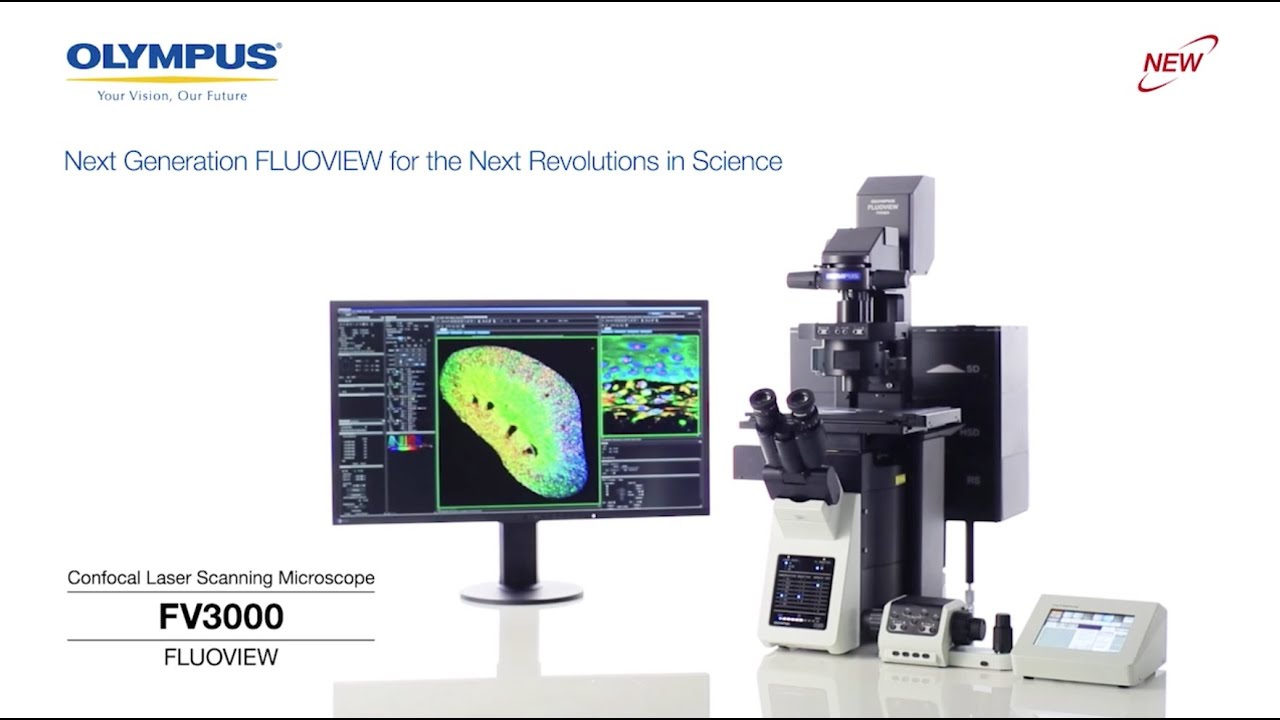
The FLUOVIEW FV3000 series is designed to meet some of the most difficult challenges in modern science. Featuring the high sensitivity and speed required for live cell and tissue imaging, the FV3000 enables 2D-6D (x,y,z,t,λ,p) macro to micro imaging of cells, tissues, and small organisms. With an intuitive and adaptable user interface, the FV3000 supports complete workflows from image acquisition to processing and analysis. Particular attention has been paid to the needs of cell biology, cancer research, and stem cell research, and with two new upright configurations, the FV3000 is also poised to meet the needs of neuroscience, electrophysiology, and developmental biology. The GaAsP Photomultiplier Tubes (PMTs) in the FV3000's high sensitivity detector (HSD) enable users to view samples whose emission is too weak to view with conventional detection methods. The GaAsP PMT unit incorporates two channels with a maximum quantum efficiency of 45%, and Peltier cooling that reduces background noise by 20% for high S/N ratio images under very low excitation light. Multichannel TruSpectral Detection with Sixteen-Channel Unmixing TruSpectral technology's efficient design and software enable spectral detectors to run in multichannel mode for both live and post-processing spectral unmixing with a multichannel lambda mode.
The multichannel mode facilitates constant spectral unmixing during live cell experiments, separating complex fluorescence during acquisition. With up to four different dynamic ranges from the four different channels of array, bright and dim spectral signals can be separated by independently adjusting the sensitivity of each detector. Fucci induced Spheroid of HT29 cell line Yuji Mishima, Ph.D., Kiyohiko Hatake M.D., Ph.D. Clinical Chemotherapy, Cancer Chemotherapy Center, Japanese Foundation for Cancer Research.
Macro to Micro Imaging and Super Resolution Macro to Micro Observation Finding areas of interest in samples can be challenging. The confocal optical design of the FV3000 series supports macro to micro imaging from 1.25X up to 150X, so users can quickly switch from low magnification overview observation to high-magnification, detailed observation of regions of interest. Users can employ image stitching at both macro and micro levels to generate overview images that show samples in context.
A stitched image of a coronal section (30 μm thickness) from an adult YFP-H mouse cerebrum acquired with 20X objective (UPLSAPO20X). Image data courtesy of Takako Kogure and Atsushi Miyawaki, Cell Function Dynamics, Brain Science Institute of RIKEN. Powerful One-Click Macro Analysis with cellSens Images alone are not enough; with integrated cellSens Count and Measure analysis, the FV3000 Series can optimize images with deconvolution and analyze them with one-click macro functionality for a broad range of morphological measurements. A spheroid image of a NMuMG cell line expressing Fucci2. Image data courtesy of Atsushi Miyawaki, Cell Function Dynamics, Brain Science Institute of RIKEN. Olympus Super Resolution (FV-OSR) Technology with Up to 4 Simultaneous Channels Olympus’ widely applicable super resolution method requires no special fluorophores and works for a wide range of samples. Ideal for colocalization analysis, the Olympus Super Resolution imaging module can acquire four fluorescent signals either sequentially or simultaneously with a resolution of approximately 120 nm., nearly doubling the resolution of typical confocal microscopy. The imaging module is easy to use with minimal user training and can be added to any confocal system, making it a truly accessible method for achieving super resolution.
Subject to objective magnification, numerical aperture, excitation and emission wavelength, and experiment conditions. Secondary antibody labels against GFP (Alexa Fluor 488, neurons) and SV2 (Alexa Fluor 565, red). Sample courtesy of Dr.
Ed Boyden and Dr. Fei Chen, MIT. Cell line: HeLa (human cervical cancer cell line) Immunostaining: Hec1 staining (green, Alexa Fluor 488), α-tubulin staining (red, Alexa Fluor 568),DAPI staining (blue) Mitotic spindle and kinetochores are stained with anti-α-tubulin (red) and anti-Hec1 (green) antibodies, respectively. Chromosomes interact with microtubules of the mitotic spindle via kinetochores (protein structures assembled on the centromere region of chromosomes.) Image data courtesy of Masanori Ikeda and Kozo Tanaka, Department of Molecular Oncology, Institute of Development, Aging and Cancer, Tohoku University.
COS7 cells, triple staining, DAPI (cyan), Actin Bodipy-FL(green), Tubulin AF568 (red) Image data courtesy of J. Doehner and U. Ziegler, Center for Image Analysis and Microscopy, University of Zurich Image Analysis The FV3000 incorporates various optional analysis functions to complete the workflow from image acquisition through data analysis. The Count and Measure solution enables the measurement of the number, size, luminosity, and morphology of the segments. Colocalization enables the analysis of overlapping fluorescent spectra. Increase Productivity with High Speed Imaging Galvanometer and Hybrid Galvo/Resonant Scanner Users have their choice of two different types of scan units: galvanometer only with the FV3000 or hybrid galvanometer/resonant with the FV3000RS. The hybrid scan unit has a galvanometer scanner for high-precision scanning, as well as a resonant scanner that is ideal for high-speed imaging. With the galvanometer scanner and Olympus super resolution technology (FV-OSR), users can obtain resolutions down to 120nm with a high signal-to-noise ratio.
By modifying the Olympus FluoView laser scanning confocal microscope. Microscope based on the Olympus FV-300 system (FV-300 sidemounted to a. This sale is for one Olympus BX61 Laser Scanning Confocal Microscope system. Olympus FluoView FV300 confocal Module without controller, cable.
The galvanometer scanner also features flexible scanning options, including precise tornado scanning as well as multipoint stimulation with 100ms switching time. The galvanometer scanner can image up to 16 frames per second.
By switching to the resonant scanner, users can capture 30 frames per second with a full field of view at 512 x 512 pixels. By clipping down to 512 x 32 pixels, the resonant scanner can capture up to 438 frames per second to capture critical live physiological events such as calcium ion flux. No Compromise between Speed and Field of View Many high-speed scanning methods restrict the field of view, limiting their usefulness for examining large areas with multiple cells. The FV3000 series’ resonant scanner maintains a full 1X field of view, even at a video rate of 30 frames per second. B clipping the Y axis, additional speeds up to 438 frames per second can be achieved. A431 cells fixed with methanol labeled with Abcam Anti-ERK1 + ERK2 antibody (Alexa Fluor 488) ab208564 and Anti-alpha Tubulin antibody (Alexa Fluor 594) ab195889 and DAPI.
Leica Sp5 Confocal Manual
Sample courtesy of Abcam. Optimized for Live Cell Imaging Resonant scanning greatly reduces photobleaching and phototoxicity compared to standard galvanometer scans by preventing the excitation of fluorophores into triplet states that create reactive oxygen species. These features make live cell experiments more robust and reliable. The FV3000 series has complete laser intensity control from low to high range, enabling the system to use the minimum required amount of laser power on samples. The optional laser power monitor provides consistent laser power during long-term time-lapse imaging across multiple days. Ratio Imaging and Intensity Modulated Display (IMD) The FV3000's ratio imaging analysis function includes an Intensity Modulated Display (IMD) function in the software that displays quantitative fluorescence ratio changes during both standard and high-speed acquisitions.
This function is particularly useful for calcium and FRET imaging where a pure ratio display provides poor contrast in background areas. Bioluminescence of RA-induced differentiating cells at day 12 from Bmal1:luc stably transfected ES cells Image data courtesy of: Kazuhiro Yagita, M.D. Department of Physiology and Systems Bioscience, Kyoto Prefectural University of Medicine Reference: Proc Natl Acad Sci U S A. 107(8): 3846–3851(2010) Accurate Time-lapse Imaging Maintain Focus with Z-Drift Compensation (ZDC) System The IX3-ZDC2 Z-drift compensator uses minimally-phototoxic infrared light (laser class 1) to identify the location of the sample plane.
One-shot autofocus (AF) mode enables several focus positions to be set as desired for deeper samples, enabling efficient Z-stack acquisitions in multiposition experiments. The continuous AF mode keeps the desired plane of observation precisely in focus, avoiding focus drift due to temperature changes or the addition of reagents, making it ideal for measurements that require more stringent focusing. Furthermore, the increased optical offset enables continuous AF with plastic vessels or with dry objectives. The Z-drift compensator is also compatible with silicone objectives (in AF mode). Multi-area time-lapse and stitching provide robust and accurate time-lapse data, and enable users to generate detailed overview images to see their data in context. The well navigator function provides sophisticated, intuitive controls for a wide range of cell culture vessels and custom plates.
Stable Time-Lapse Imaging with the IX83 Microscope A Z-drive guide installed near the revolving nosepiece combines high thermal rigidity with the stability of a wraparound structure to significantly reduce the impact of heat and vibration and improve the quality of time-lapse imaging. The umbra unit is designed specifically for fluorescence observation under bright room conditions. It efficiently blocks out room light, enhances the contrast of fluorescence, and enables clear fluorescence observation without the need for a dark room.
Reduce Complexity with the Sequence Manager With the Sequence Manager software module, complex protocols are handled with ease and accurate timing. Multi-day time-lapse experiments are controlled with microsecond scan accuracy and millisecond sequence execution accuracy. Various protocols, such as time-lapse with different time intervals, switching between high and low magnification, and photo-stimulation between imaging by FRAP or FRET (acceptor photobleaching), can be performed. In deep tissue observation, image quality depends on keeping the refractive index of the sample and immersion medium as close to each other as possible. When working with a silicone immersion objective, the difference between the refractive index of the samples and silicone oil is minimal, thus enabling brighter fluorescence images with higher resolution for deep tissue observation.
Performance Comparison of the PLAPON60XOSC2 and the UPLSAPO60XO Reduce Spherical Aberration The correction collar adjusts the lens position of objectives to correct the spherical aberration caused by refractive index mismatch, resulting in the improvement of image quality, such as resolution, brightness and contrast. The correction collar is especially necessary for objectives with high NA when they are used for super resolution imaging, because they are greatly affected by spherical aberration. The remote correction collar unit is useful for easy adjustment and improvement of the image quality, and operable on all UIS2 objectives which have a correction collar.
Layout Start by selecting your preferred display with specific tools for basic to complex acquisition. Acquisition Condition Reload settings that were ideal for your last experiment to provide consistency. Acquisition Activate basic to complex acquisitions with live ratio, intensity modulated display, quantitative region of interest (ROI) graphing or spectral unmixing display, and data backup for added security.
Viewer Review data as it is generated. Generate 3D and 4D views and animations to explore and share data in depth. Analysis Extract data from images using online or offline processing. Analytical tools include Olympus super resolution technology (FV-OSR) and powerful cellSens software with features such as deconvolution, filtering, count and measure, and one-click macros. Solutions for Neuroscience The FV3000 confocal laser scanning microscope is compatible with a variety of objectives from 1.25x to 150x, enabling both macro overviews as well as high-resolution image acquisition. Obtain images of whole brain tissue sections to get easily identify areas of interest, and then switch to a high magnification objective to acquire high-resolution images of target neurons.
You can even observe the fine structure of dendritic spines using Olympus super resolution technology. With the system’s TruSpectal detection technology, it’s possible to image neurons labeled with multiple colors and clearly separate the individual spectra. Dendrite (anti-GFP Alexa Fluor 488, green) and synaptic marker (SV2, Alexa Fluor 565, red). Olympus super resolution image processed with cellSens software’s advanced constrained iterative deconvolution. Average full width half maximum measurements —135 nm. Image acquired with 100X, 1.35 NA silicone objective.
Sample courtesy of Dr. Ed Boyden and Dr. Fei Chen, MIT FV3000 Upright System — Electrophysiology Configuration This configuration offers a larger working space, so there’s more room around the objective for electrophysiology equipment. You can add additional space by lowering the height of the stage to accommodate experiments that involve large samples. Fast phenomena, such as calcium ion dynamics related to neuronal signal transmission, can be captured at up to 438 frames per second with the available resonant scanner. With the TTL signal I/O interface box, you can synchronize image acquisition with electrophysiology experiment.
Additionally, you can use the remote control software development kit to control both your FV3000 microscope and your electrophysiology equipment from a single software platform.