2017 Jaguar S Type Phone Manual
Not everything in life has to be rational or practical. Such is the case with the 2017 Jaguar F-Type, which is one of our favorite sports car indulgences. First off, it's drop-dead gorgeous, with flowing and graceful shapes mixed in with aggressive edginess and taut proportions. It's a compact plaything that fits like a custom-tailored garment. Sure, you may have to give up some comfort and convenience, but for performance-oriented drivers, those sacrifices are easily ignored.
The Good The 2017 Jaguar F-Type Coupe's. Driver's phone for connected features and does not support Android Auto or Apple CarPlay. Manual shifting with. Used 2017 Jaguar F-TYPE S Convertible AWD. Aware that Jaguar also offered a manual transmission for the first few years of the larger S-TYPE sedan's run.
Aug 17, 2016 - With only two seats, the 2017 Jaguar F-Type R Coupe is a dedicated. The Bad The infotainment head unit relies on the driver's phone for connected. Manual shifting with the eight-speed automatic transmission shows a little lag. And entertainment software looks familiar from Jaguars of recent years.
For 2017, the F-Type lineup grows on each side of the budget spectrum. A more affordable base model debuts, surrendering some features in the process but still delivering all of the style. There's also a new SVR model that pushes the performance parameters even higher than the already stunning F-Type R. Of course, there's hasn't been a shortage of competing sports cars to consider against the F-Type's price that now ranges from $60,000 to well over $100,000. It's most direct rivals include the, and. Other less conventional alternatives like the Chevrolet Corvette, Porsche Cayman/Boxster and Nissan GT-R may also be worth consideration. The good news is, there's not a bad choice in the bunch.
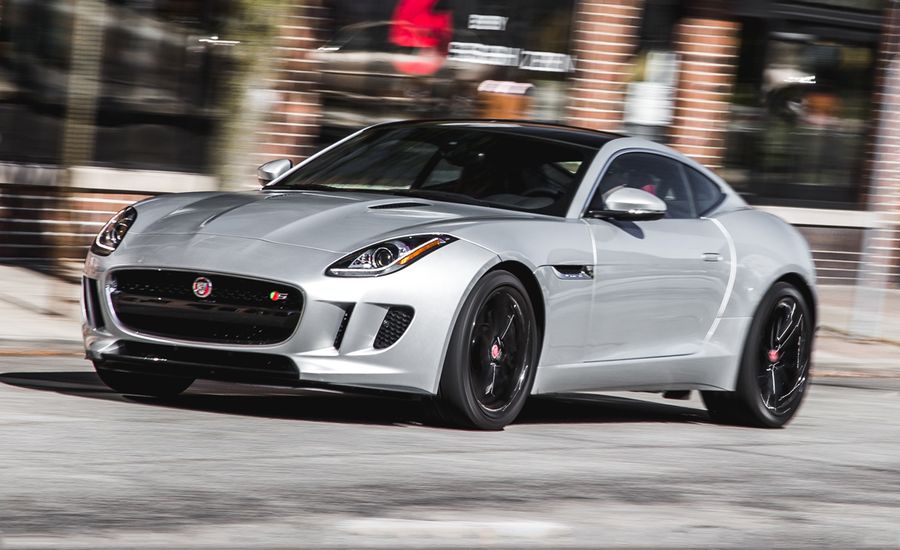
So go ahead, loosen your tie or let your hair down and just get out there and have some fun behind the wheel. After all, what are you more likely to remember, practicality or how good you feel behind the wheel? Standard safety features on all 2017 Jaguar F-Type models include antilock disc brakes, stability and traction control, seat-mounted side airbags and rollover protection bars for the convertible. A rearview camera, rear cross-traffic alerts and front and rear parking sensors are standard on the British Design Edition and SVR trims and optional on all others except for the base model.
Rear parking sensors are also included with the F-Type R. In Edmunds testing, an F-Type V6 S with rear-wheel drive took 106 feet to come to a stop from 60 mph, an average stopping distance in this class. An all-wheel-drive F-Type R with optional carbon-ceramic brakes fared marginally better, stopping in just 104 feet.
Standard features for the base F-Type include 18-inch wheels, automatic xenon headlights with washers, automatic wipers, LED running lights, heated mirrors, an auto-deployed rear spoiler, a sport-tuned suspension, a selectable sport exhaust system (for models with a manual transmission) and keyless ignition. Convertible models add a power-folding three-layer fabric top and rollover hoops for added safety. On the inside, you get automatic climate control, an auto-dimming rearview mirror, textured aluminum and synthetic leather interior trim, leather and synthetic suede seating surfaces, six-way partially power-adjustable seats, a power tilt/telescoping steering wheel, Jaguar InControl Apps (infotainment, remote control and emergency telematics), an eight-inch touchscreen, a navigation system, Bluetooth phone and streaming audio and a 12-speaker Meridian audio system with a CD player, USB/iPod input and Satellite/HD radio. The Premium trim adds keyless entry, power-folding mirrors, a panoramic sunroof (for coupe models), adaptive headlights with automatic high-beams and 14-way power-adjustable seats with driver memory functions. The F-Type S increases power output and adds 19-inch wheels, additional body louvers and accents, adaptive and selectable suspension dampers, high- performance brakes, a mechanical limited-slip differential, driver-configurable drive settings (ride stiffness, exhaust volume and engine/transmission response), alloy pedals (for the automatic transmission only), configurable interior ambient lighting and a flat-bottomed steering wheel. The F-Type R upgrades to a V8 engine along with 20-inch wheels, upgraded performance brakes, an active electronic differential, a power rear hatch for coupes, a wind deflector between the convertible roll hoops, rear parking sensors, dual-zone automatic climate control, heated performance seats with premium leather, a heated steering wheel, contrasting interior upholstery stitching and a universal garage door opener.
A new British Design Edition adds many of the F-Type R features to the F-Type S model along with unique flourishes to celebrate the car's origins. Also included are front parking sensors, a rearview camera, a blind-spot monitor and rear cross-traffic alerts. At the top of the range, the SVR trim builds upon the F-Type R with a more powerful V8, a lightweight titanium exhaust system, a permanent active rear spoiler, a synthetic suede headliner, quilted leather seat surfaces and the electronic driver aids from the British Design Edition. Many of the premium features are available as options on supporting trims. Other notable options include carbon ceramic brakes, a carbon fiber coupe roof, a heated windshield, various black and carbon fiber exterior trim and additional interior leather surfaces.
Both the base and Premium F-Type trims are powered by a supercharged 3.0-liter V6 engine that produces 340 horsepower and 332 pound-feet of torque. Power is sent to the rear wheels through either an eight-speed automatic or six-speed manual transmission. The F-Type S increases output to 380 hp and 339 lb-ft of torque. All-wheel drive is available as an option but must be paired with the automatic transmission. The F-Type R receives a 5.0-liter supercharged V8 that is good for 550 hp and 502 lb-ft of torque.
The SVR ups the ante with 575 hp and 516 lb-ft. The eight-speed automatic transmission and all-wheel drive are mandatory for all V8 models. In Edmunds testing, a rear-drive F-Type S reached 60 mph in 5.2 seconds with the manual transmission while the automatic bested it with a 5.0-second result. Jaguar estimates that adding all-wheel drive will add another tenth of a second.
As respectable as these times are, they're still as much as a full second slower than some rivals. The F-Type R blasts through 60 mph in only 3.5 seconds and we expect the SVR to be a few tenths quicker. The for the base V6 are 23 mpg combined (20 mpg city/28 mpg highway) for the automatic and 19 mpg combined (16 city/24 highway) for the manual. The rear-drive F-Type S models drop by only one mpg overall while the all-wheel drive is rated at 21 mpg combined (18 city/26 highway). The F-Type R and SVR are estimated at 18 mpg combined (15 city/23 highway). There are two main traits that draw people into the Jaguar F-Type: style and performance.
The V8-powered models deliver both. Acceleration is breathtaking, accompanied by an epic roar from the engine and exhaust.
In Dynamic mode, the sound is even more fierce, with smile-inducing crackles when lifting off the gas pedal. The V6-powered F-Types are much more sedate, but not what anyone would consider slow or underpowered. Engine response is still praiseworthy but much of the V8's raucous theatrics are gone. For less performance-oriented drivers, that's a good thing.
We do caution shoppers to avoid the manual transmission in favor of the automatic, though. The manual's clutch suffers from an awkward engagement point and occasionally slips under hard acceleration, emitting an acrid burning smell. The automatic further earns its mettle with quicker acceleration and better fuel economy. Handling with any of the F-Types is commendable. The immediacy of the steering response, coupled with confidence-inspiring levels of grip make it one of the most entertaining cars you'll ever drive. All-wheel drive adds even more cornering ability, though we do miss the tail-happy antics of the rear-drive F-Type R that was discontinued a few years ago.
The F-Type benefits from excellent interior materials and craftsmanship. As the first sports car in the company's lineup in decades, the F-Type snugly wraps around the driver and passenger. Rather than feeling as though you're sitting in the driver seat, it feels more like you're wearing the car. Taller occupants will have just enough headroom but they may not have enough legroom. Visibility is also limited, with rather thick roof pillars that may obstruct the view through tighter turns and the coupe's small rear hatch window. That small hatch also limits cargo capacity with a narrow opening and only 11 cubic feet of cargo.
Most golf bags will not fit, but a few overnight bags will. The convertible is even smaller at 7 cubic feet. In addition to space, the sports car focus also sacrifices some comfort in exchange for performance.
The ride quality is firm enough to cause some fatigue on longer road trips and there is also an abundance of road and engine noise. Most won't mind the engine noise as much, however, since all of the engines sound great.
Of greater concern is the firmness of the seats which will likely cause uncomfortable hard points. As stylish as the F-Type's cabin is, it lacks some of the technological sophistication of rivals. The infotainment system lags behind competitors with slow responses to inputs, unintuitive menus and screen graphics that look outdated. On the plus side, the 12-speaker Meridian stereo delivers strong and clear tones and is standard on even the base model. Edmunds expert review process This review was written by a member of Edmunds' editorial team of expert car reviewers. Our team drives every car you can buy.
We put the vehicles through rigorous testing, evaluating how they drive and comparing them in detail to their competitors. We're also regular people like you, so we pay attention to all the different ways people use their cars every day.
We want to know if there's enough room for our families and our weekend gear and whether or not our favorite drink fits in the cupholder. Our editors want to help you make the best decision on a car that fits your life.
The Verdict: The 2017 XE, Jaguar's first small sport sedan in nearly a decade, is a dynamic car that rides exceptionally well. Warts show up in cabin materials and interior space, but it's a worthwhile consideration nonetheless. Versus the competition: The XE isn’t the roomiest or most luxurious choice in a crowded class, but it’s among the most fun to drive. On sale now, the Jaguar XE comes in four trim levels plus a limited-run First Edition, each with a turbocharged four-cylinder gasoline or diesel engine, or a supercharged gas V-6. Rear-wheel drive and an eight-speed automatic transmission are standard; all-wheel drive is optional with the diesel and V-6. Stack up the trim levels.
I drove rear- and all-wheel-drive XEs at Jaguar’s Colorado media preview, testing both the V-6 and the diesel four-cylinder. I had already put a V-6 XE through an autocross handling course near Cars.com’s Chicago headquarters. A caveat on ride quality: All the sedans I drove in Colorado had Jaguar's optional adaptive suspension, the fanciest of three setups. Jaguar also offers fixed suspensions with regular or sport tuning in the XE, but I can't comment on ride quality with either setup. Exterior & Styling The Jaguar XE’s straightforward styling should age well. The nose looks like a pared-down XJ or XF, while the taillights incorporate cues from the F-Type roadster, with a clean, squared-off design.
Alloy wheels range from 17 to 20 inches in. Show full review. The Verdict: The 2017 XE, Jaguar's first small sport sedan in nearly a decade, is a dynamic car that rides exceptionally well. Warts show up in cabin materials and interior space, but it's a worthwhile consideration nonetheless. Versus the competition: The XE isn’t the roomiest or most luxurious choice in a crowded class, but it’s among the most fun to drive.
Jaguar
On sale now, the Jaguar XE comes in four trim levels plus a limited-run First Edition, each with a turbocharged four-cylinder gasoline or diesel engine, or a supercharged gas V-6. Rear-wheel drive and an eight-speed automatic transmission are standard; all-wheel drive is optional with the diesel and V-6. Stack up the trim levels. I drove rear- and all-wheel-drive XEs at Jaguar’s Colorado media preview, testing both the V-6 and the diesel four-cylinder.
Jaguar S-type Wiki
I had already put a V-6 XE through an autocross handling course near Cars.com’s Chicago headquarters. A caveat on ride quality: All the sedans I drove in Colorado had Jaguar's optional adaptive suspension, the fanciest of three setups.
Jaguar also offers fixed suspensions with regular or sport tuning in the XE, but I can't comment on ride quality with either setup. Exterior & Styling The Jaguar XE’s straightforward styling should age well. The nose looks like a pared-down XJ or XF, while the taillights incorporate cues from the F-Type roadster, with a clean, squared-off design. Alloy wheels range from 17 to 20 inches in diameter and the top R-Sport trim has some subtle ground effects. How It Drives In my initial handling course in Chicago (read my early thoughts ), the rear-drive XE with the supercharged V-6 revealed masterful dynamics. The nose tucks instantly into corners and the tail drifts free, with plenty of warning, for as long or as little as you'd like. A drive on mountain switchbacks near Aspen, Colo., proved that the XE's all-wheel drive — which sends almost all the power to the rear wheels under normal circumstances — delivers nearly as much fun.
With the turbocharged diesel, the XE is every bit as dynamic as a BMW 3 Series or Cadillac ATS — two benchmark rivals for handling. The car rotates controllably and instantly, uphill or downhill. All-wheel drive and the supercharged V-6 give the XE its heaviest curb weight (about 200 pounds heavier than the diesel or rear-drive V-6 sedans I also drove) and it shows up in the form of soupier reflexes — chiefly, a touch slower steering turn-in and hints of understeer. Still, the chassis keeps body motions in check; even at its portliest, the XE stays flat as you accelerate, corner and brake.
The 180-horsepower, turbo-diesel four-cylinder's robust torque — 318 pounds-feet, which is nearly as much as the supercharged V-6 — makes for gratifying low-rev acceleration, while the 340-hp, supercharged V-6 pulls with lag-free urgency. Jaguar's eight-speed automatic is an occasional hindrance to both engines, lagging on downshifts or gear-hunting through them when you call for more power. Two sportier settings (one accessible via the gearshift itself, the other through a driving-mode selector) shore up some of the lag, but it's just another example that high gear counts do not a good transmission make. Ride quality is a high point. With the adaptive suspension and 18-inch rims, the XE takes on broken pavement, tar patches and rapid elevation changes with outstanding control. The 19s introduce a degree of chop, but even then, ride quality still shows a lot of polish. The turbo four-cylinder gas engine that I didn't test makes 240 hp, but Jaguar offers it only with rear-wheel drive.
There’s a manual transmission available in the Jaguar XE abroad but not here, something that probably upsets me more than it does 95 percent of XE shoppers. Interior As fun as the Jaguar XE is to drive, some will find the cabin too small or spartan. The sedan is wider than its German rivals, but the cabin feels narrow up front and skimpy on headroom all around. The short windows limit forward and rearward visibility, and the doors are an ergonomic lapse — a mishmash of outcroppings, none of them at the right position or length to be an armrest. Legroom and seat height are both adequate in back, but the limited headroom means taller passengers will have Calvin hair by trip's end. (That's of, not Coolidge or Klein.) Cabin materials are impressive in certain areas, particularly with the XE's optional vinyl-wrapped dashboard. But there's a degree of consistency elsewhere in the class that's lacking here.
You don't have to look hard to see where Jaguar stashed cheaper, lower-grade plastics — places the 3 Series, Mercedes-Benz C-Class and other cars trim with richer materials. Some rivals have in their cheaper variants, but the XE's bottom trims have a grade of vinyl that won't fool anyone who looks closely.
Ergonomics & Electronics The standard multimedia setup includes an 8-inch touch-screen with physical shortcut keys, HD radio, a USB and iPod interface, and Bluetooth hands-free phone and audio streaming. Two Meridian premium stereos are optional, as is a 10.2-inch display that replaces the 8-inch screen and shortcut keys. Its on-screen shortcut buttons are less intuitive than the smaller screen's physical ones, but it's otherwise a first-rate setup, with a navigation system that allows you to pinch and swipe at smartphone speeds.
The 8-inch screen also offers navigation, but it's a slower, rudimentary system by comparison. With either screen, an optional app interface supports many third-party applications off a connected iPhone or Android smartphone, but and are unavailable. Cargo & Storage Typical of a small sport sedan, the Jaguar XE’s cabin storage is tight. The center console won’t hold much; a nook ahead of the gearshift is good for a medium-size smartphone. Trunk space, however, is impressive.
At 15.9 cubic feet, the XE rivals many midsize sedan trunks. Safety The Jaguar XE has not been crash-tested.
Jaguar offers all the expected safety technologies, but it’s expensive to actually get them. A backup camera, which is standard on many non-luxury cars, is optional on the base XE. And you can’t get forward collision warning and automatic emergency braking — an important safety feature that’s standard in the C-Class and Audi A4 — until the XE’s top trim. Value in Its Class Pricing starts in the mid-$30,000s and extends to just south of $67,000 with all options; that spread is comparable to other sport sedans. A moonroof and power seats are standard and, if you throw in crowd-pleaser options like a backup camera and heated seats, you can get a nicely equipped Jaguar XE with rear-wheel drive and the turbo four-cylinder for roughly $37,000 — fairly affordable, as similarly equipped rivals go. Throw in Jaguar's, which includes complimentary maintenance, and the XE is an interesting choice for driving enthusiasts, albeit less tempting if you want a bona fide luxury car or need to cart family and friends around. Send Kelsey an Hide full review.
Crash and Rollover Test Ratings The 2017 Jaguar XE has not been tested. What is a Bumper-to-Bumper warranty? Often called a basic warranty or new-vehicle warranty, a bumper-to-bumper policy covers components like air conditioning, audio systems, vehicle sensors, fuel systems and major electrical components.
Most policies exclude regular maintenance like fluid top offs and oil changes, but a few brands have separate free-maintenance provisions, and those that do offer them is slowly rising. Bumper-to-bumper warranties typically expire faster than powertrain warranties. What is a Powertrain warranty? Don't be misled a 10-year or 100,000-mile powertrain warranty doesn't promise a decade of free repairs for your car. It typically covers just the engine and transmission, along with any other moving parts that lead to the wheels, like the driveshaft and constant velocity joints. Some automakers also bundle seat belts and airbags into their powertrain warranties.
With a few exceptions, powertrain warranties don't cover regular maintenance like engine tuneups and tire rotations.